
SEO
Law Firm SEO in 2026 – The Complete Guide to Legal Search Visibility
By Daniel Mercer | February 15, 2026

By Daniel Mercer | February 15, 2026


In 2026, the building supplies market is divided. On one side, you have DIY homeowners; on the other, professional Trade Buyers. Effective SEO must bridge this gap. Building Merchants can no longer rely on simple product listings. To win, you must optimize for real-time inventory visibility, bulk specification searches, and frictionless mobile ordering for contractors on the job site.
Search Engine Optimization (SEO) has become crucial for businesses, including those in the fire safety industry. In 2026, SEO trends are expected to shape how fire safety companies enhance their online presence. This article will provide valuable insights and strategies to help your business stay ahead.

In 2026, Voice Search is no longer just about smart speakers reading weather reports. With the rise of Apple Intelligence, Gemini Live, and ChatGPT Voice, users are holding complex, multi-turn conversations with search engines. To rank in this era, brands must move beyond simple keywords and optimize for Conversational Context and “Speakable” Schema.

In the age of Uber and Lyft, the traditional Taxi industry has evolved. Users no longer search for “Taxi” when they want a quick ride—they open an app. However, users DO search Google for reliability: Airport Transfers, Long-Distance trips, and Corporate Accounts. In 2026, SEO for taxi firms is about dominating these high-value, pre-planned journeys.
| Metric | 2026 Target / Benchmark |
|---|---|
| High-Value Keyword | “Airport Transfer [City]” (Highest Conversion Rate) |
| Local SEO Priority | Top 3 “Map Pack” Ranking is non-negotiable |
| Mobile Experience | “Thumb-Zone” Design (Sticky Click-to-Call buttons) |
| Voice Search | Optimizing for “Call a cab near me” |
| Page Speed (CWV) | Under 2.5 seconds (Essential for mobile users) |
As an SEO agency, we drive growth for competitive fleets including:
Rideshare apps are notorious for surge pricing and cancellations during early morning hours. This is where SEO wins. By optimizing your site for “[City] to [Airport] Taxi”, you target customers looking for reliability over speed. These keywords have a lower search volume than generic terms but a significantly higher booking value.
We help you structure your site to capture these high-ticket fares.
When a user searches “Taxi near me,” they rarely look past the top 3 results on the Google Map. In 2026, ranking here depends on:
We provide comprehensive local SEO tips to help you stay in the top 3.
60% of taxi websites fail because they are hard to use in a rush. If a user cannot find the “Call” or “Book” button within 1 second, they bounce back to Uber. Your website must feature a Sticky Booking Bar that stays visible as the user scrolls.
Ensure your website converts traffic with our mobile optimization services.
With the rise of Siri and Google Assistant, 30% of taxi bookings are initiated via voice: “Hey Google, call a taxi.” To capture this, your site needs specific Schema Markup (Organization and LocalBusiness) that tells search engines your phone number is the primary interaction point.
Find out more with our voice search optimization guide.
The average cost-per-click (CPC) for “Taxi” keywords can be high (\$3.50+), especially when competing with rideshare giants. An effective strategy uses SEO for long-tail keywords (e.g., “Wheelchair accessible taxi [City]”) to get free traffic, while using Google Ads strictly for high-margin airport runs.
Optimize your ad spend with our PPC management services.
To survive in 2026, Taxi companies must stop trying to be an app and start acting like a premium service. Focus on Airport Transfers, Local Map dominance, and corporate reliability.

Designing effective prompts for Large Language Models (LLMs) has evolved from an art to a science. In 2026, “asking a question” is not enough. To achieve enterprise-grade results, you must use structured frameworks, Chain of Thought (CoT) reasoning, and precise constraint definitions. This guide covers the advanced architecture of high-performance prompts.
| Component | Function |
|---|---|
| Persona / Role | Assigns specific expertise (e.g., “Senior SEO Strategist”) to anchor the model’s knowledge base. |
| Chain of Thought | Instructs the AI to “think step-by-step” before generating the final output, reducing hallucinations by 40%. |
| Few-Shot Prompting | Providing 2-3 examples of the desired output style to calibrate the model immediately. |
| Negative Constraints | Explicitly stating what not to do (e.g., “Do not use passive voice” or “Do not summarize”). |
| Output Formatting | Defining the exact structure (Markdown table, JSON, HTML) for the result. |
The biggest mistake users make is diving straight into the task. In 2026, the most effective prompts follow the R.T.F. Framework:
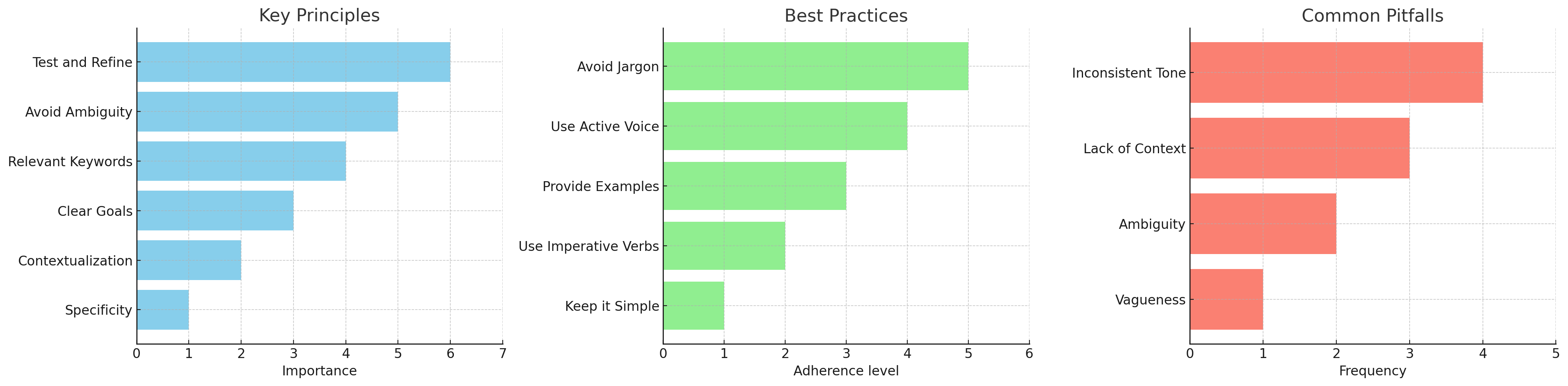
For complex tasks, LLMs perform significantly better when asked to plan their response. This is called Chain of Thought prompting.
Standard Prompt: “Write a marketing plan for a new shoe brand.”
CoT Prompt: “First, analyze the current sneaker market trends for 2026. Second, identify three gap opportunities for a new brand. Third, based on those gaps, write a comprehensive marketing plan. Think step-by-step.“
This method forces the model to logically deduce the answer rather than predicting the next likely word.
Simple prompts yield simple results. To generate high-ranking SEO content, you need a “Mega-Prompt” that controls tone, structure, and intent. Below is a blueprint for a high-level SEO prompt.
The “SEO Master” Prompt Blueprint:
“Act as an expert SEO Content Strategist. Your goal is to write a comprehensive guide on [TOPIC] that outranks the current top result.Context: The audience is B2B C-Suite executives. The tone should be authoritative, data-driven, and concise. Avoid fluff and corporate jargon.
Steps:
1. Create an outline based on semantic entities and user intent.
2. Write the content using short paragraphs and active voice.
3. Include a ‘Key Takeaways’ table at the start.
4. Ensure the reading level is Grade 8 for maximum readability.Constraints: Do not use words like ‘unleash’, ‘unlock’, or ‘delve’. Do not self-reference as an AI.
Output: Clean HTML.”
Discover more on leveraging AI for growth on our Content Creation Services page.
Adhering to frameworks like Chain of Thought and R.T.F. will transform your output from generic text to expert-level content. In the AI era, the quality of your output is determined entirely by the quality of your input.
For more insights on integrating AI into your workflow, refer to our comprehensive SEO Services.
We invite you to contact Calvin Agency for personalized assistance with building custom AI Agents for your business.

In the high-stakes world of logistics, SEO is no longer about just getting traffic—it’s about getting the right contracts. As we move into 2026, the industry is dominated by automation and sustainability. Logistics companies must pivot their SEO strategies to target Supply Chain Managers and Procurement Officers who are searching for reliability, tech integration, and green credentials.

In the digital age, the cosmetic surgery industry is hyper-competitive. Patients no longer just search for “plastic surgeon”; they search for specific procedures, recovery times, and social proof. As we move into 2026, clinics must adopt Medical SEO strategies that prioritize patient trust and authority to acquire high-value leads.