landed
Posts by Calvin Crane:
VPS (Virtual Private Server) Hosting Demystified
VPS Hosting Guide
Key Takeaways:
| Benefit | Details |
|---|---|
| Improved Performance | Dedicated resources improve website speed and stability |
| Enhanced Security | Isolated environments provide better protection against threats |
| Greater Control | Full root access allows for custom software installations |
| Scalability | Easily upgrade resources as your site grows |
| Cost-Effectiveness | More affordable than dedicated hosting with similar benefits |
Introduction
In today’s rapidly evolving digital landscape, a reliable and efficient web hosting solution is pivotal for businesses and individuals alike. Virtual Private Server (VPS) hosting has emerged as a cornerstone in this arena, providing an exemplary balance between performance, security, and cost. The transition from traditional shared hosting to VPS signifies a quest for better control and improved website performance.
Understanding Cloud Hosting
VPS hosting serves as a bridge between the affordability of shared hosting and the robustness of dedicated hosting. Operating on a technology that divides a single physical server into multiple virtual servers, each user operates independently of the others. This unique structure offers a perfect blend of cost, flexibility, and performance, making it an ideal choice for websites with growing needs.
Learn more about the intricacies of this technology in our in-depth guide on Understanding Cloud Hosting.

Benefits of VPS Hosting
VPS hosting provides several advantages that cater to a variety of web hosting demands. Performance is significantly improved due to allocated resources like RAM and CPU. Additionally, it offers enhanced security thanks to an isolated environment. Customization is another merit, as users have root access to the server. Lastly, scalability allows for the easy addition of resources.

Technical Insights
Delving deeper, VPS hosting distinguishes itself with its technical framework. Unlike shared hosting, where resources are distributed amongst multiple users leading to potential performance bottlenecks, VPS ensures dedicated resources for each user. This guarantees stability and speed, critical for businesses and high traffic websites.

Choosing a VPS Host
Selecting the right VPS hosting provider is crucial. Criteria include reliability, round-the-clock customer support, state-of-the-art hardware, and competitive pricing. Ensure the provider aligns with your specific requirements to fully leverage the power of VPS hosting.

Real-World Applications
VPS hosting proves versatile, catering to e-commerce platforms, applications, and large websites that demand reliable performance and swift scaling capabilities. Its robust framework supports the intricate needs of these platforms, providing them the foundation to thrive.
Discover more about successful online strategies in our resource, A Note About Indexing and Backlinks.

Security and VPS Hosting
Security is a paramount concern in today’s digital age. VPS hosting affords a higher level of security compared to shared hosting due to its isolated environments. Users can further bolster their security with custom firewalls and additional measures.
Case Studies
Real-world deployments of VPS hosting illustrate its potential to revolutionize business operations. From improved website performance to enhanced security measures, businesses leveraging VPS hosting enjoy numerous benefits, underlining its effectiveness.
Explore cutting-edge digital strategies at The Future of Search.
Conclusion
VPS hosting embodies a modern solution to web hosting challenges, striking a balance between cost, performance, and control. As we look ahead, the adaptability and efficiency of VPS hosting render it a highly viable option for anyone seeking an upgrade from shared hosting or an affordable alternative to dedicated servers. Embracing VPS hosting today can set the stage for unprecedented growth and security in the digital domain.
Understanding Cloud Hosting
Key Takeaways
| Benefit | Detail |
|---|---|
| Scalability | Adjust resources based on demand. |
| Performance | Enhanced speed and uptime. |
| Cost-Effectiveness | Pay for what you use, reducing unnecessary expenditures. |
| SEO Benefits | Improved loading times lead to better SEO rankings. |
| Global Reach | Distribute content worldwide efficiently. |
Introduction to Cloud Hosting
Cloud hosting is revolutionising the way websites operate, offering unmatched flexibility, scalability, and efficiency. This modern hosting option allocates resources from a cluster of multiple servers, ensuring your website is never dependent on a single server’s resources. As digital landscapes become increasingly complex, the importance of reliable, scalable hosting solutions like cloud hosting cannot be overstated.
For a deeper understanding of your website’s current hosting capabilities and performance, explore our Website Technical Audit service.
The Technical Backbone of Cloud Hosting
The core of cloud hosting lies in its infrastructure, including data centers spread across numerous locations, virtualization software, and scaling capabilities. This setup allows for data mirroring, ensuring your site remains online and performs optimally, even in the event of hardware failure.
Link building plays a pivotal role in enhancing site performance, particularly in a cloud-hosted environment. Learn more about our approach through our Link Building service.
SEO and Cloud Hosting: A Symbiotic Relationship
The speed, uptime, and global reach offered by cloud hosting are not just technical advantages but also SEO benefits. Fast-loading pages reduce bounce rates and enhance user experience, factors that search engines reward with higher search rankings.
For insights into maximizing these SEO benefits, see our guide on Indexing and Backlinks.
Hiring for Cloud Hosting Management
Choosing the right SEO management approach—be it in-house, agency, or freelance—is crucial for effectively leveraging cloud hosting’s capabilities. Each option has its benefits, from the direct oversight of in-house teams to the extensive expertise and resources of agencies.
Dive deeper into this comparison with our article on In-House SEO vs Agency SEO vs Freelance SEO.

Creating Content in the Cloud Era
Cloud hosting enables dynamic content creation, distribution, and scalability like never before. Modern CMS platforms leverage cloud hosting to handle varied traffic loads efficiently, ensuring your content reaches its audience reliably and swiftly.
For strategies that blend well with cloud hosting benefits, visit our Content Creation Loop page.
Conclusion: The Future of Web Hosting
Cloud hosting represents a significant leap forward in web hosting, providing businesses of all sizes with tools and capabilities previously reserved for large enterprises. With its inherent scalability, reliability, and global reach, cloud hosting is well-suited to the demands of today’s digital environment.
We encourage businesses to explore the potential of cloud hosting for their online presence. The advantages it brings in terms of performance, SEO, and cost-efficiency can transform how your website operates and competes in the global market.
Understanding cloud hosting is not just about recognizing its technical underpinnings but also about appreciating how it can reshape business strategies and online experiences. As we move forward, cloud hosting continues to evolve, offering new possibilities for innovation, growth, and competitive advantage.

The Content Creation Loop
Briefly here is how you can evolve your SEO content through a SOP Standard Operating Procedure with a client. This is a cycle to follow indefinitely and ensures that your content stays fresh and to a high standard.
We will assume there is a content ‘piece’
Also, we aim to have rich content- videos graphics etc maybe also interactive elements which are engaging for the user.
The loop is a continuous cycle with the following stages:
- Review Piece
In the initial stage, thoroughly review the existing content. Understand its current performance in search rankings and user engagement.
You may be looking to optimise for a specific keyword. Or you may have such a piece that is too far away to evolve and a faster route is to scrap it! This is by far the most complex step and will require a deep understanding of SEO and AI.
Identify specific goals for your content. Are you aiming for higher visibility, improved user engagement, or conversions? Based on these goals, suggest changes that can help you reach them.
- Suggest Changes to Achieve Specific Goals
As an agency, we don’t own the content and we won’t be the only interested party. Often there are trade-offs with other stakeholders. So the changes need this stage of approval.
- Create Changes
Once the changes are agreed then make them!
Implement the changes you’ve suggested. This could involve optimizing keywords, improving readability, adding multimedia elements, or any other content enhancements.
- Measure the Effect of Changes
After implementing the changes, closely monitor the impact on your content’s performance. Use tools like Google Analytics or SEO software to track changes in search ranking, organic traffic, and user interaction. How quickly changes will happen and to what degree is difficult to say but it doesn’t now take much longer to see initial change. You would see some movement within 10 days- often less. Note this is different to waiting for Google core updates which happen less often which the changes in the loop will be designed to combat.
Remember, the key to success in iterative development is continuous monitoring and adjustment. Your ‘content’ should emphasize the importance of this ongoing process in achieving and maintaining high search rankings. SEO shouldn’t be thought of as a one-shot job. We are way beyond the simple 3 kings of domain, title and headings. Or simply sprinkling the keyword in the content. By all means, if you are doing a DIY SEO then go for it. Those elements DO need to be right. This iterative development cycle is to combat harder to rank for topics with serious competition.
The future of search
Such is Google dominance in the search market we are very familiar with using it as a verb- to ‘Google something’ two words shorter than saying ‘search on the net’.
Before Google however we used Yahoo, Alta Vista, Lycos.
We get confused between search engines and browsers too, Google entwined the two and also took a massive share of the software cake too. Microsoft isn’t good at knowing or caring what people want. It focuses on what made it a giant – the corporate business. Something Google is managing to get some of through it’s cloud based infrastructure. So Google came in with Chrome and innovated where internet explorer just continued to annoy.
What is Netscape, Go.com, Dogpile, Ask Jeeves..
We get the point
Is Google going to dominate the market?
Can you classify ChatGPT as a search engine? The important thing is be the tool people reach for to get information online. Bing with it’s AI tool got a rare head start on Google with it’s Bard. And ChatGPT has revolutionised content creation to the point where many writers must be somewhat worried. Sidenote- I had an online content battle with someone who refused to acknowledge that AI could create. We need to accept it can. Music Graphics, weird graphics!
So are things yet to shake up again.
Google has been carving up it’s top 10 real estate so that even occupying spot #1 leaves you down the page. Advertisers rule, money rules hey Abba. Makes the world go round. But Google is triallng SGE Search Generative Experience firstly through it’s labs and it seems a lot like the Bing AI search experience.
Did you know that Google tried to index every book ever written?
They did.
They fought the law and the law won. Thanks to a few god men and women.
It occurred to me that they are getting companies writers and SEO professionals to create the worlds content! They can through showing them the gaps where content is missing but people search. Low hanging fruit SEO pros call it. Create an article that has good volume but which lacks decent solutions.
It struck me that this was like their attempt to digitise the worlds books. Making libraries and books obsolete in a sense. When Google shows the answer to a search which is text from a website to a person and the person doesn’t need to visit the website even, it seems the same. SGE, Bing AI and ChatGPT and others can interrogate the internet your website , mine his and hers.
But can we assume that Google WILL be the dominant force in a decade. No. I don’t believe it is sure at all. Having seen big fish flop (Myspace, Yahoo etc.) and feeling the same way when I first used ChatGPT made me feel like the first time I used Google. We would flip showing little loyalty.
So what, my SEO peers- and you others, do you think? Search has to evolve and AI is here to stay.
Hamish speaks about SGE
Be the first to comment!
In House SEO Vs Agency SEO Vs Freelance SEO
As head of marketing, you realise you are losing some market share to SEO. Maybe you have been doing PPC Advertising but on key terms and missing out on a good chunk of longer tail keywords that PPC wouldn’t work for.
Assigning budget to marketing channels I am no expert at however I do know that data is used to back up decisions. The point being there was data showing you need to up your SEO game. And you realised that you got sold a bum deal on all that SMM which promised the moon and delivered little return.
Budget likely removes the option of having a dedicated IN HOUSE SEO for many after you work out all the costs of having another employee. The bigger companies may also cover various roles within SEO. It is rare to find a good technical SEO guy if they happen to be good at SEO however it is way easier to skill up any technical SEO guy as the skills for a technical SEO are far greater than those of SEO. However, I should give a nod to the SEO who has been around a long time and has the instinct. There is an art to it. And some Dev Ops experience Technical SEO dudes will lose out on that front.
The Considerations
In many respects, a smaller website can be technically fixed up and optimised and then the job is done- at least for a while. So this favours hiring a good technical SEO Freelancer and then hiring a good SEO Freelancer for the rest. An agency will of course have these skills inside and that is their key strength. Being able to draw on senior SEO staff for bigger questions. Running a whole SEO team in-house must be more expensive than hiring an agency. So small and medium-sized businesses can bring their SEO up to scratch by getting a reputable agency. I say that like it’s easy. Finding a good agency isn’t trivial.
Hmmm, why is it that Freelance jobs are rare? I really don’t get that. Again maybe the difficulty in finding good ones and hiring a bad one is pretty big. Still, you have to apply the same risks to in-house and agency searches anyway. Seriously consider finding a great SEO Freelancer.
I believe that Social Media was not the solution it was purported to be, I also feel like Content Marketing isn’t either. Don’t get me wrong you need content but some of you are going nuts and it may need a clean-up in aisle 5 down the line. So what does continuous SEO look like?
Well, you need to be linkable and create link-worthy assets from within the market and industry.
Have some off-site campaigns within tight guidelines. No, I am not talking about buying links.
Keep an eye on technical SEO and performance-related stats.
Keep an eye on the day-to-day SEO tasks.
Have a content strategy in place that is right for your business and just not as much as we can spew out. Seriously the spewing needs to stop.
So SEO Freelancers may be the best value way to get that SEO performance back.
How to find a good SEO freelancer?
A good SEO freelancer should be able to rank for some decent traffic terms right? Their website should be optimised for indexing and show all the good things you need. Good speed and good UX. Be wary of clicking on an Ad at the top of search result pages. All this does is show that they know how to create a Google Ad unless they even hired a Google Ads Agency. Be wary of freebies you work in marketing cmon!
Look for good SEO case studies with modern examples. Old charts are no good for today’s tougher search algorithms.
How to find a good SEO Agency?
Meticulously going through their cases studies and talking to them is a starting point. My expertise on hiring an agency is zero. I just know SEO. Good luck.
Hope you enjoyed this article.
A note about indexing and backlinks
I always get emails from those link traders who sell links- duh! Well, they send you an Excel sheet or Google Sheet with a bunch of attractive DA urls and some metrics. I’m hoping you know what I mean so you’re the right audience for this SEO post about backlinks.
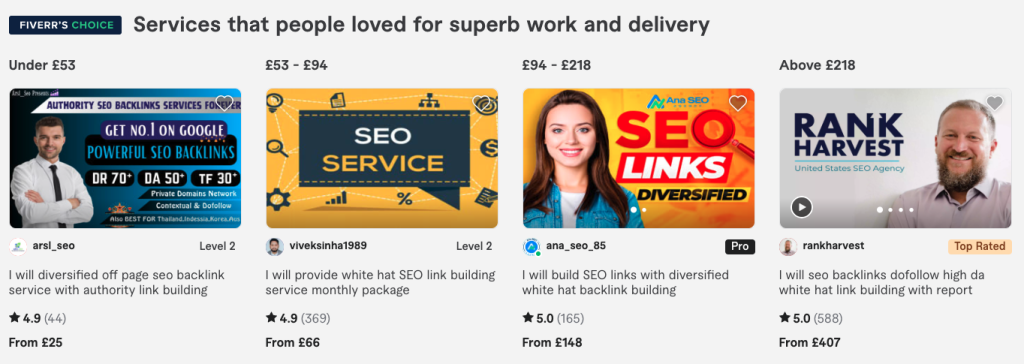
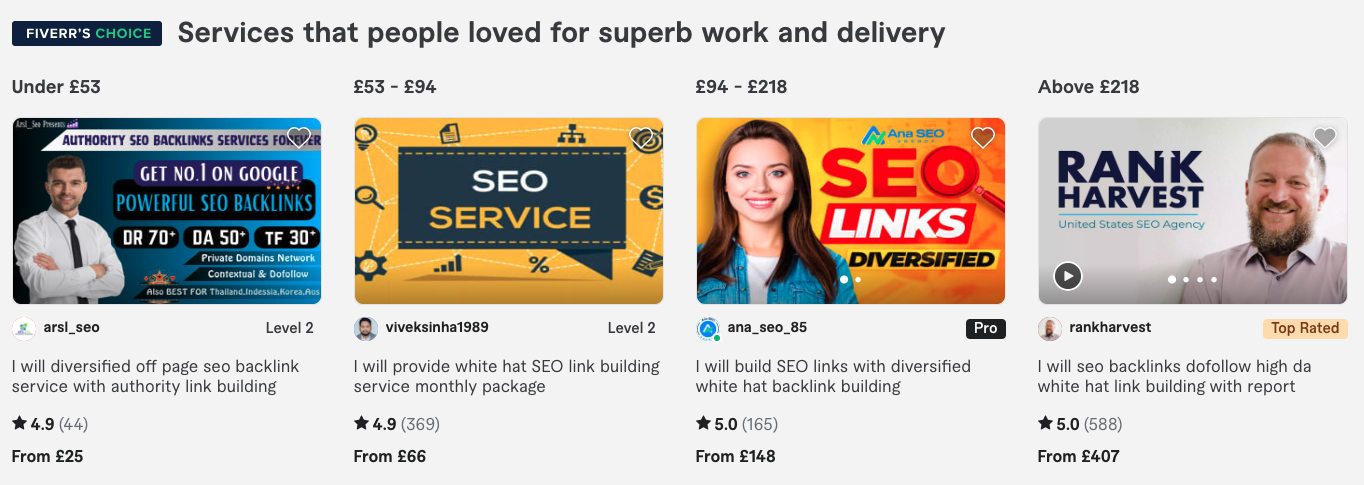
Are backlink gigs on Fiver any good? NO.
It concerns me that I see the same kind of rubbish for sale on Fiver. Worse than the 5-star reviews roll in- more on that later. You are actually better off just throwing your money down the toilet or sending it to me because I will spend it better.
What are you missing? Those of you just trying to jump on the SEO bandwagon which isn’t a great bandwagon but I suppose for scammers it is. This is especially for you. Learn about indexation and how to see if a page can be indexed.
View a pages source code and check for the following:
<meta name="robots" content="follow, index, max-snippet:-1, max-video-preview:-1, max-image-preview:large"/>
This meta tag tells crawlers who obey robots such as Google (bad bots don’t care) that this page will be followed and indexed. In fact, the default is follow and index so you don’t even need these directives. So what you need to search for on the page’s source code is “nofollow” and “noindex”. If you find these or either one by itself, the page is not good for links.
A non-indexed page is not thought to be counted because of the likelihood of not being crawled and the importance of the page is low, so noindex is bad.
A non-followed page discounts all of the links- in terms of passing link juice however there could still be some benefit for these links in the sense of a diluted vote. We simply don’t know how Google treats them. The nofollow vs follow conversation is one to watch. It is beyond the scope of this rant.
Here is the complete Google specification of the use https://developers.google.com/search/docs/crawling-indexing/robots-meta-tag
What the links are missing is a key point of INDEXATION, and therefore TRAFFIC. These pages where your links turn up are typically profile pages the high DA sites like sony.com (it doesn’t matter who) allow anyone to create. These member pages or similar are blocked from being indexed to save SEO for the domain. If they were indexed then Google would see the ‘Link Farm’ which these pages become. Do you pay for links on Facebook or on Twitter? NO for the same reason. There could be a social effect if they were influential pages but not an SEO benefit.
When a page isn’t indexed the links are worthless. Google is maybe allowed to crawl the page (if the crawl budget ever allows it) but it isn’t going to assign any value to these links.
Stop buying these kinds of backlinks. And absolutely stop rating these providers 5 stars on Fiver.
This is why people invest in guest posting on blogs and websites with traffic in relevant niches. I also like link insertions into articles that already have traffic through being indexed and known by Google and other search engines.
Link building is time-consuming and therefore expensive. So better to aim for a few links drip-feeding alongside onsite SEO and get your site technical SEO approved too. The rate at which you build links should appear natural. Another reason why getting even 10 links all of a sudden is a red flag. It’s easy to spot.
My journey in cycling a couple of years in
It’s been quite a while since I last posted. I have now learned much from my own experience and GCN is well a super-channel on YouTube. I have been researching and learning about bikes. But to mention all of the cycling mad creators on there too. I will post a couple of my recommendations at the end.
I would like to say that I have ridden more than I have but life gets in the way. The main points of concern have been wrist issues and clipless pedals.
Wrist issues.
I get a lot of discomfort from my wrists and this is on smaller bikes and mountain bikes big fat soft tyres etc…I had thought a better-fitting bike would be the answer but it’s not going to be. Still, a pair of carbon forks is on the list. I am looking for an Endurance Road Bike. The search is still on and I may just buy all my components and make it up as I go. This is the main thing holding me back from riding much longer than 2 hours at the moment. If I push through the discomfort then I start getting a sensation that the handlebars are separate and sawn in half in the middle and a shearing motion is happening. Bizzare right?
Clipless Pedals
I inherited a pair of older Shimano shoes with cleats having the 3 bolt system and yellow tips. These have more ‘float’ than the red and are supposedly easier to get in and out of. Yes, I have forgotten at times to unclip and at others not be able to and have fallen over. I’m in the club. Upon realising that I like road cycling I got some new ones courtesy of my loving partner. And so I thought I would invest in new cleats. Ebay let me down. I didn’t realise that the cleats came in poor quality too. So invest in proper Shimano cleats not copies. They simply aren’t safe. I just didn’t know and just bought a pair from eBay.
So what happened? I had to go looking for the adjustable screw in the pedal to slacken off the tension making them easier to get in but still, it was a real fight. My first ever ride I was never in the bloody thing on the right I believe it was. I kept persevering with them. On sorting the ability to clip in unclipping was not always easy and this is where it gets dangerous. Once coming toward a stop I got so frustrated I put so much force (twisting out) into unclipping that I tore the cleat plastic. Something I said is not right. I bought what appeared to be proper Shimano cleats and well no issues at all. That’s the end of that small cycling story, the moral is yes you can blame the tools.
Bike building and maintenance
I have interestingly started to build up an interest in the building of bikes. So there is a world of difference between putting together new clean components and working on dirty old messes that you can barely improve but that need maintaining. My TDF (Tour De France) is just developing a bottom bracket squeak. Man, they are annoying eh? I am hoping that it’s something that worked loose and needs a dismantle cleaned and put back together. The BB isn’t the easiest thing to work on without tooling though.
I now know all the components quite well, now own a bike stand and can index a derailer gear set and adjust my brakes.